
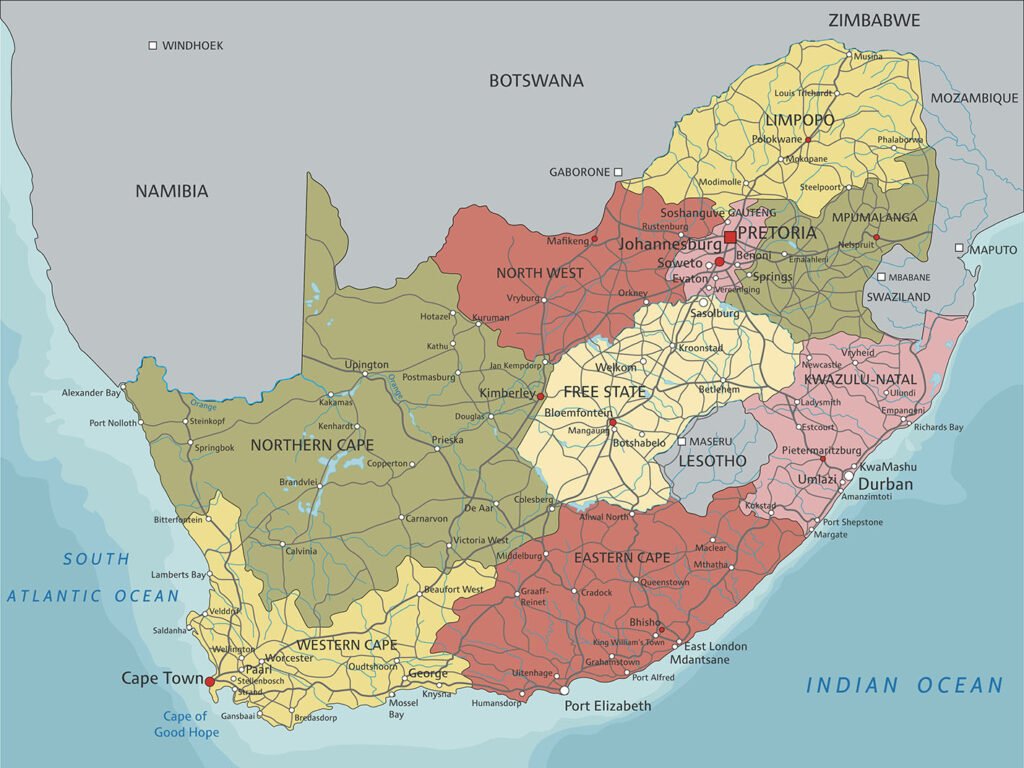
The Nine Unique Provinces of South Africa: History, Highlights & Culture
South Africa divides its territory into nine distinct provinces, each offering its own character, landscape, and cultural identity. These provinces range from the vast, sparsely populated Northern Cape to the small but densely packed economic center of Gauteng. Each province has its own government, premier, and executive council that manages local affairs.
The nine provinces are the Eastern Cape, Free State, Gauteng, KwaZulu-Natal, Limpopo, Mpumalanga, Northern Cape, North West, and Western Cape, established on April 27, 1994, following the country's first democratic elections. This system replaced the previous structure of provinces and homelands that existed under apartheid rule.
Understanding these provinces helps visitors and residents alike grasp the diversity packed into one nation. From the beaches of KwaZulu-Natal to the vineyards of the Western Cape, from the wildlife reserves in Limpopo to the historic battlefields in the Free State, each province contributes unique features to South Africa's identity. The differences in size, population, economic focus, and natural attractions make each province worth exploring on its own terms.
Overview of South Africa's Provincial System
South Africa reorganized its entire provincial structure in 1996, dismantling the apartheid-era homelands and creating nine distinct provinces from the previous four-province system. Each province now operates with its own legislature, premier, and executive council while contributing differently to the national economy.
History of Provincial Boundaries
Before 1996, South Africa operated under a four-province system. The country included the Transvaal and Orange Free State, which were formerly Boer republics, along with Natal and the Cape, which had been British colonies.
These four states merged in 1910 to form the Union of South Africa under British rule. The country became the Republic of South Africa in 1960.
During the 1970s and 1980s, the apartheid government implemented a "separate development" policy that created homelands. These territories were established on disconnected parcels of land with little economic value. Laws forced black South Africans to become citizens of these regions, stripping them of South African citizenship.
The 1996 democratic constitution eliminated the homelands system and consolidated the country into nine provinces. This restructuring restored citizenship rights and created the current provincial boundaries that exist today.
Governance and Administration
Each of the nine provinces has its own government structure with a legislature, premier, and executive council. Provincial legislatures contain between 30 and 80 members depending on population size.
The provinces connect to national governance through the National Council of Provinces. Each province sends 10 representatives to this council, with six permanent members and four special delegates.
Provincial governments have the authority to pass laws in specific limited areas. They handle regional matters while national government manages broader policy decisions. This system allows provinces to address local needs while maintaining national unity.
Economic Significance
The provinces vary dramatically in their economic contributions. Gauteng produces 33.8% of South Africa's GDP despite being the smallest province by land area at just 18,178 square kilometers.
KwaZulu-Natal contributes 16% to the national economy, followed by the Western Cape at 13.7%. These three provinces together generate nearly two-thirds of the country's total economic output. The Northern Cape, while occupying 30.5% of the country's land area, contributes only 2.1% to GDP.
Different provinces specialize in different industries. Mining dominates in North West, Limpopo, and Mpumalanga. Finance and services drive the economies of Gauteng and the Western Cape. Manufacturing plays a major role in KwaZulu-Natal.
Historical Development of the Nine Provinces
South Africa's provincial structure changed dramatically in 1994 when the country moved from four provinces to nine. This shift dismantled the apartheid-era homeland system and created a new framework for democratic governance.
From Four to Nine Provinces
Before 1994, South Africa operated with four provinces: Cape, Natal, Orange Free State, and Transvaal. These provinces were remnants of British colonial rule and did not reflect the needs of a democratic society.
On April 27, 1994, the country held its first non-racial elections and adopted an Interim Constitution. This historic date marked the dissolution of the old provinces and the establishment of nine new ones.
The nine new provinces were introduced specifically for the 1994 general election. Each province received its own government and representation in the national parliament through a Council of Provinces. The new divisions included Eastern Cape, Northern Cape, Western Cape, Free State, KwaZulu-Natal, Gauteng, North West, Limpopo, and Mpumalanga.
Apartheid Era and Homelands
The apartheid government created separate territories called homelands where black South Africans were forced to live apart from white people. These homelands operated as quasi-independent states with limited resources and rights.
The homeland system fragmented the country and created severe inequality. Black South Africans lost citizenship rights in "white" South Africa and were confined to overcrowded, underdeveloped areas. In 1996, following the 1994 democratic elections, the new constitution officially dismantled all homelands.
This reintegration process merged the former homeland territories back into South Africa proper. The dissolution allowed previously excluded populations to participate fully in the nation's governance and economy.
Formation of Current Provincial Borders
The pre-democracy negotiations between the African National Congress and the National Party established the framework for nine provincial governments. These talks replaced the four apartheid-era provinces with a more representative structure.
The new borders combined portions of old provinces with reintegrated homeland territories. This created provinces with more diverse populations and resources. In December 2005, the 12th amendment to the constitution adjusted some provincial borders to improve administrative efficiency.
Each province now has its own government and symbols that reflect its unique heritage and identity. The provincial system allows local governments to address regional needs while maintaining national unity.
Comparing the Provinces: Size, Population, and Density
South Africa's nine provinces show major differences in how much land they cover and how many people live there. Gauteng packs over 15 million people into a tiny urban area, while the Northern Cape spreads just over 1 million residents across vast desert landscapes.
Land Area Differences
The Northern Cape takes up almost a third of South Africa at nearly 372,000 square kilometers, making it the largest province by far. The Eastern Cape comes second at 168,966 square kilometers.
In sharp contrast, Gauteng covers only 18,178 square kilometers. This makes it just 1.4% of the country's total land area. The Western Cape, Free State, and KwaZulu-Natal fall somewhere in the middle for size.
Limpopo, Mpumalanga, and North West provinces also have moderate land areas. These size differences play a big role in how people spread across the country.
Population Statistics
Gauteng holds 15,931,824 people, making up 25.3% of South Africa's total population. KwaZulu-Natal ranks second with 12,312,712 residents at 19.5% of the national total.
The Western Cape has 7,562,588 people (12%), while the Eastern Cape has 7,176,230 people (11.4%). Limpopo follows with 6,402,594 residents at 10.2%.
Mpumalanga has 5,057,662 people (8%), and North West has 4,155,303 (6.6%). The Free State holds 3,044,050 people at just 4.8%. The Northern Cape has the smallest population with only 1,372,943 residents, representing 2.2% of the country.
Population Density Patterns
Gauteng has nearly 700 people per square kilometer, making it the most densely populated province. Its highly urbanized nature creates a sharp contrast with other areas.
The Northern Cape sits at the opposite end with less than four people per square kilometer. Its mostly desert terrain and hardscrabble farmland cannot support many residents.
KwaZulu-Natal and the Western Cape show moderate to high population density due to their cities and economic centers. The Eastern Cape, despite its large population, spreads people across a bigger area. Limpopo, Mpumalanga, Free State, and North West maintain lower densities with more rural landscapes.
Eastern Cape: Heritage, Landscape, and Cities
The Eastern Cape stands as South Africa's second largest province by land area, covering 169,580 square kilometers. This province holds deep historical significance as the birthplace of legendary leaders like Nelson Mandela, Desmond Tutu, and Steve Biko, while its diverse landscapes range from pristine beaches to mountain ranges.
Geography and Climate
The Eastern Cape is the only province in South Africa to contain all seven ecological zones within its boundaries. This remarkable diversity creates varied climates across the region, from coastal areas to inland mountains.
The province stretches along 800 kilometers of Indian Ocean coastline. It features sandy beaches, secluded lagoons, and rocky cliffs that form its most prominent natural feature.
The climate offers more than 300 sunny days annually. Rainfall patterns vary across the region, with Pondoland in the east receiving higher precipitation and holding some of the richest soils in the country. Winter brings snow to inland mountains, while coastal areas maintain moderate temperatures year-round.
Natural resources include grazing land, forests, marine life, and fertile farming soils. The diverse climate supports crops like pineapples, tea, tomatoes, and chicory across different areas of the province.
Cultural and Historical Highlights
The Eastern Cape preserves a rich cultural heritage from Xhosa traditions and colonial history. Portuguese explorers first settled the area in 1488, followed by British settlers in 1820.
The region witnessed numerous conflicts between the Khoisan, Xhosa, British, Dutch, and Germans. These historical events shaped smaller towns like Bathurst, Grahamstown, and Cradock, where heritage sites remain preserved.
Xhosa-speaking South Africans dominate the population, with Afrikaans and English speakers making up 11% and 6% respectively. The province holds 6.6 million people, representing 13% of South Africa's total population.
The Eastern Cape Provincial Heritage Resources Authority works to identify, document, and protect cultural heritage resources throughout the region. This effort aims to transform the cultural landscape for sustainable community development.
Major Cities and Attractions
Bhisho serves as the provincial capital and seat of government, located 60 kilometers west of East London in the Buffalo City Metro area. The city houses 13 government departments and state-owned enterprises.
Port Elizabeth functions as the largest economic center within the Nelson Mandela Metropolitan area. The city anchors the automotive industry, which produces half of South Africa's passenger vehicles.
East London operates as the economic hub of the Buffalo City Metropolitan area. The city hosts one of three provincial harbors alongside Port Elizabeth and Ngqura.
The province maintains malaria-free game reserves where visitors can view the Big 7: buffalo, elephant, leopard, lion, rhino, Great White sharks, and Southern Right whales. Four beaches earned Blue Flag status: Dolphin Beach in Jeffrey's Bay, Kelly's Beach in Port Alfred, Kariega in Kenton-on-Sea, and Humewood Beach in Port Elizabeth.
Gauteng: Economic Powerhouse and Urban Centers
Gauteng produces over a third of South Africa's total economic output despite being the country's smallest province by area. The province contains two major cities that serve distinct roles: Johannesburg as the financial center and Pretoria as the seat of government.
Johannesburg: The Heart of Gauteng
Johannesburg stands as South Africa's largest city and primary economic hub. The city generates significant wealth through its finance, real estate, and business services sectors.
The Johannesburg Stock Exchange operates as Africa's largest securities market. Major banks, insurance companies, and multinational corporations maintain their headquarters in the city's business districts. Sandton has emerged as a key financial district, hosting numerous corporate offices and luxury developments.
Mining history shaped Johannesburg's development, though the city's economy has diversified considerably. Manufacturing, technology, and professional services now play major roles. The city's infrastructure includes OR Tambo International Airport, which handles the majority of South Africa's international air traffic.
Soweto, located in Johannesburg's southwestern area, represents an important historical and cultural component of the metropolitan region. The township played a central role in South Africa's liberation struggle.
Pretoria: Administrative Capital
Pretoria serves as South Africa's executive capital and houses the Union Buildings, where the president's offices are located. The city contains numerous government departments and foreign embassies.
The city maintains a different character from Johannesburg, with wide streets lined with jacaranda trees. Pretoria's economy relies heavily on government services, which represent a significant portion of economic activity.
Educational institutions contribute to the city's identity. The University of Pretoria ranks among South Africa's largest universities. Research facilities and specialized institutions focus on areas including agriculture, veterinary science, and technology.
Pretoria merged with surrounding municipalities to form the City of Tshwane Metropolitan Municipality in 2000. The metropolitan area extends beyond the original city boundaries.
Urbanization and Infrastructure
Gauteng contributes 33.2% to South Africa's GDP, making it the nation's economic engine. The province hosts approximately 15 million residents in a relatively small geographic area.
The Gautrain rapid rail system connects Johannesburg, Pretoria, and OR Tambo International Airport. This infrastructure project improved public transportation options for commuters and travelers. Major highways link the province's urban centers and connect to other provinces.
Population density creates challenges for service delivery. Water supply, electricity distribution, and waste management require constant investment. Housing demands continue to grow as people migrate to the province seeking employment opportunities.
Industrial areas concentrate around Johannesburg's eastern and western regions. Factories produce vehicles, electronics, textiles, and processed foods for domestic and export markets.
KwaZulu-Natal: Coastal Beauty and Zulu Heritage
KwaZulu-Natal stretches along South Africa's eastern coast, combining warm Indian Ocean beaches with rich Zulu cultural traditions. The province features major cities like Durban and Pietermaritzburg, alongside protected wilderness areas that support diverse wildlife.
Durban and Coastal Attractions
Durban serves as KwaZulu-Natal's largest city and main port. The Golden Mile beachfront attracts swimmers and surfers year-round with its warm subtropical waters.
uShaka Marine World offers one of Africa's largest aquariums. Visitors can see sharks, dolphins, and penguins in themed exhibits.
The KZN South Coast beaches include popular destinations like Uvongo, Margate, and Southbroom. Many beaches hold Blue Flag status for safety and water quality.
Durban's Indian Market provides spices, textiles, and crafts. The city's Indian community shapes local cuisine, making it famous for bunny chow and curries.
Popular Coastal Activities:
- Surfing and swimming at protected beaches
- Diving at Aliwal Shoal and Protea Banks
- Whale watching from June to November
- Fishing from piers and charter boats
Pietermaritzburg: Cultural Insights
Pietermaritzburg functions as KwaZulu-Natal's capital city. Victorian-era buildings line the streets, reflecting British colonial history.
The Tatham Art Gallery displays South African and European artwork. The building itself dates back to 1871 and serves as an architectural landmark.
Visitors can experience authentic Zulu cultural traditions through art, dance, and musical performances at heritage facilities throughout the region. Traditional homesteads demonstrate Zulu customs and beadwork crafts.
The battlefields around Pietermaritzburg mark significant Anglo-Zulu War sites. Isandlwana and Rorke's Drift tell stories from 1879 conflicts.
Natural Wonders and Reserves
The Drakensberg Mountains form a UNESCO World Heritage Site along KwaZulu-Natal's western border. Hikers access trails ranging from easy walks to challenging multi-day treks.
Hluhluwe-iMfolozi Park protects the Big Five and leads global rhino conservation efforts. Game drives offer wildlife viewing throughout the year.
iSimangaliso Wetland Park combines coastal forests, lakes, and coral reefs. The park supports hippos, crocodiles, and over 500 bird species.
Reserve Highlights:
| Reserve | Key Features |
|---|---|
| Hluhluwe-iMfolozi | Rhino conservation, Big Five safaris |
| iSimangaliso | Wetlands, marine life, UNESCO status |
| Oribi Gorge | Hiking, abseiling, scenic views |
| Mkuze | Bird watching, rare species |
Over 50 game reserves and protected areas operate across KwaZulu-Natal. These spaces preserve natural habitats while supporting eco-tourism activities.
Western Cape: Cape Town and Diverse Landscapes
The Western Cape sits on the south-western coast of South Africa and serves as home to Cape Town, the country's legislative capital. This province attracts visitors with its contrasting landscapes that range from coastal areas to mountain ranges and fertile wine regions.
Cape Town: Iconic City
Cape Town stands at the foot of Table Mountain as one of the most beautiful cities in the world. The city functions as both the provincial capital and the legislative capital of South Africa.
Visitors find a blend of natural beauty and urban development throughout the metropolitan area. The city offers access to both the Atlantic and Indian Oceans, creating unique coastal experiences. Table Mountain provides a dramatic backdrop and serves as a major landmark visible from many parts of the city.
The urban center combines modern infrastructure with historic architecture. Cape Town's position at the southern tip of Africa gives it strategic importance and creates a distinct climate pattern.
Winelands and Coastal Tourism
The Western Cape features world-class wines and wonderful whale watching opportunities across its diverse terrain. The Winelands region produces internationally recognized wines in fertile mountain valleys.
Coastal areas show striking differences along the province's shoreline. The drier West Coast contrasts sharply with the green Garden Route, which runs along the eastern coastal section.
Tourism thrives throughout the province due to these varied landscapes. Whale watching draws visitors during migration seasons. The Garden Route provides scenic drives and outdoor activities. Adventure options exist throughout the region, from mountain hiking to water sports.
Cultural Sites and Heritage
The province displays significant cultural diversity through its heritage sites and local communities. Multiple language groups call this region home, contributing to a rich cultural mix.
Historic sites reflect the province's role in South Africa's complex past. Cape Town contains buildings and landmarks from different periods of settlement and governance. Museums and cultural centers preserve and present this history to visitors.
Local cuisine reflects the cultural diversity and rich food traditions found throughout the region. The combination of coastal resources, agricultural products, and diverse cultural influences creates distinctive food experiences. Markets and restaurants showcase both traditional dishes and contemporary interpretations.
Other Unique Provinces: Profiles and Highlights
Four provinces showcase South Africa's diverse landscapes, from ancient rock formations and wildlife-rich areas to vast desert expanses and important mining regions. These areas span from Limpopo in the north to the expansive Northern Cape, each offering distinct attractions and economic activities.
Limpopo: Ancient Lands and Natural Treasures
Limpopo sits in South Africa's northern region and shares borders with three countries: Zimbabwe, Botswana, and Mozambique. The province contains some of the country's oldest rock formations and archaeological sites.
Polokwane serves as the provincial capital and acts as a major commercial center. The city connects travelers to the wider region through its transport networks.
The province features part of Kruger National Park, one of Africa's largest game reserves. Visitors can spot the Big Five animals in their natural habitat. The Mapungubwe Cultural Landscape holds UNESCO World Heritage status and preserves evidence of ancient kingdoms that thrived between 900 and 1300 CE.
Baobab trees, some over 1,000 years old, dot the landscape. The province's subtropical climate supports diverse plant and animal species. Agriculture plays a key role in the local economy, with farms producing tea, tropical fruits, and vegetables.
Mpumalanga: Wildlife and Adventure
Mpumalanga means "the place where the sun rises" in local languages. The province occupies a relatively small area but packs numerous natural attractions into its landscape.
Mbombela, formerly known as Nelspruit, functions as the capital city. The city serves as a gateway to popular tourist destinations in the region.
The province contains a large section of Kruger National Park along its eastern border. The Panorama Route offers stunning views of geological features like Blyde River Canyon, the third-largest canyon in the world. God's Window provides panoramic views over the Lowveld region.
Adventure activities include white-water rafting, zip-lining, and hiking. The province's varied elevation creates different climate zones, from tropical lowlands to cooler highland areas. Mining and forestry contribute significantly to the provincial economy, alongside tourism.
Northern Cape: Vast Land and Mineral Wealth
The Northern Cape covers the largest land area of any province, taking up almost one-third of South Africa's total territory. Yet it has the smallest population, creating a sparse, open landscape.
Kimberley serves as the provincial capital and gained fame during the diamond rush of the 1870s. The Big Hole, a former diamond mine, remains one of the largest hand-dug excavations in the world.
The province encompasses diverse environments, from the Kalahari Desert in the north to the Atlantic coastline in the west. Namaqualand transforms each spring when millions of wildflowers bloom across the semi-desert terrain. The Augrabies Falls National Park showcases powerful waterfalls on the Orange River.
Mining remains central to the economy. The province produces diamonds, iron ore, and other minerals. Sheep farming and agriculture occur in suitable areas despite the arid conditions.
North West: Mining and Heritage
North West Province straddles areas of the former Cape Province and Transvaal. The region combines mining activities with cultural heritage sites.
Mahikeng, also called Mafikeng, is the provincial capital. The city holds historical significance from the Anglo-Boer War period. Rustenburg ranks as the largest city and serves as a major platinum mining center.
The province contains significant platinum deposits, making it a global leader in this mineral's production. Mining operations provide employment for many residents. Sun City resort complex attracts visitors with its hotels, casino, and entertainment facilities.
The Pilanesberg National Park sits in an ancient volcanic crater. The park offers Big Five game viewing in a malaria-free environment. Visitors can explore the park through self-drive routes or guided tours. The Madikwe Game Reserve along the Botswana border provides another wildlife viewing option.
Free State: Heartland of South Africa
The Free State province covers 129,464 square kilometers in the center of South Africa, making it the third-largest province by area. Bloemfontein serves as both the provincial capital and the nation's judicial center, while the region's flat grasslands support one of the country's most productive agricultural sectors.
Bloemfontein: Judicial Capital
Bloemfontein functions as South Africa's judicial capital, housing the Supreme Court of Appeal. The city sits at the center of the Free State and serves as the province's administrative hub.
The urban area experiences hot summers with average January temperatures reaching 31°C and cold winters dropping to -2°C in July. Annual precipitation averages 559 millimeters, falling mainly during summer thunderstorms. The city's elevation and continental climate create distinct seasonal patterns that affect daily life throughout the year.
Bloemfontein's historical roots trace back to the Orange Free State, a former Boer republic established on February 17, 1854. The city maintained its importance through the transition to the Orange Free State Province in 1910 and finally became part of the modern Free State province on April 27, 1994.
Landscape and Agriculture
The province sits on flat grassy plains at elevations above 1,000 meters, with the Drakensberg and Maloti Mountain foothills pushing terrain above 2,000 meters in the eastern regions. These plains rest on Karoo Sequence rocks containing shales, mudstones, and sandstones capped by Drakensberg Basalt.
The rich soil and favorable climate establish the Free State as South Africa's granary. Agriculture forms the central pillar of the provincial economy. The eastern areas around Harrismith, Bethlehem, and Ficksburg receive more rainfall, while western sections experience extreme heat and aridity during summer months.
Gold and diamond deposits provide significant mineral wealth, concentrated in the northern and western areas. Mining operations on the goldfields employ the largest workforce in the province, complementing the dominant agricultural sector.
Cultural Diversity
The 2022 census recorded a population of 2,961,864 people in the Free State. The demographic composition includes 88.9% Black African, 8.0% White, 2.6% Coloured, and 0.4% Indian or Asian residents.
Sotho speakers comprise 72.3% of the population, making the Free State the only province where native Sotho speakers form the majority. Afrikaans is spoken by 10.3% as a first language, primarily among White and Coloured communities. Additional language groups include Xhosa (5.5%), Setswana (5.3%), and English (1.5%).
The province recorded 92.7% of residents identifying as Christian in 2022, the third-highest proportion among all provinces. Traditional African religions account for 4.9% of the population, while 0.5% practice Islam. Religious diversity remains limited compared to other South African provinces.
The median age stands at 28 years, reflecting a relatively young population. Between 2011 and 2022, the Free State experienced the slowest population growth rate among all nine provinces at 8.0%.
Provincial Capitals and Major Cities
South Africa's nine provinces each have designated capital cities that serve as administrative centers, while major urban areas drive economic activity and showcase distinctive landmarks. The capital cities range from small administrative towns to large metropolitan hubs that combine governmental functions with commercial significance.
Administrative Functions
Each province has an official capital where the provincial legislature, premier, and executive council operate. Bhisho serves as the capital of the Eastern Cape, functioning primarily as an administrative center. Bloemfontein is the capital of the Free State and also houses South Africa's Supreme Court of Appeal.
Pretoria serves as Gauteng's administrative capital and is one of South Africa's three national capitals. Cape Town, the Western Cape capital, is the legislative capital of the entire nation. Pietermaritzburg functions as the capital of KwaZulu-Natal, while Mahikeng governs the North West province.
Polokwane administers Limpopo province from its position in the northeastern region. Mbombela, previously known as Nelspruit, serves as Mpumalanga's capital. Kimberley oversees the Northern Cape, the largest province by land area.
Economic Roles
The largest city in a province is not always its capital. Johannesburg dominates as Gauteng's economic powerhouse and South Africa's financial center, despite Pretoria being the administrative capital. The city generates substantial national GDP through banking, mining, and commerce sectors.
Durban serves as KwaZulu-Natal's largest city and operates Africa's busiest port, handling significant cargo volumes. Cape Town combines its capital status with major economic functions in tourism, manufacturing, and technology industries.
Port Elizabeth drives the Eastern Cape economy through automotive manufacturing. The mining industry remains central to Kimberley's economy, building on its diamond mining heritage.
Notable Urban Landmarks
Cape Town features Table Mountain, the V&A Waterfront, and Robben Island. Johannesburg contains the Apartheid Museum and Constitutional Hill. Pretoria showcases the Union Buildings and Voortrekker Monument.
Durban's Golden Mile beachfront and uShaka Marine World attract visitors year-round. Bloemfontein houses the National Museum and Naval Hill. Kimberley displays the Big Hole, a hand-dug diamond mine.
Pietermaritzburg maintains Victorian architecture in its city center. Polokwane features the Bakone Malapa Open Air Museum. Mbombela provides access to Kruger National Park.
Frequently Asked Questions
Each province has its own capital city, unique climate patterns, and economic strengths. The provinces show remarkable differences in population density, languages spoken, and tourist attractions.
What are the capital cities of each of South Africa's provinces?
Each of South Africa's nine provinces has its own capital city where the provincial government is located. Some provinces have multiple cities serving different governmental functions.
The Eastern Cape has three capitals: Bhisho for legislative purposes, Port Elizabeth for economic activities, and Grahamstown for judicial functions. The Free State's capital is Bloemfontein, which also serves as South Africa's judicial capital.
Gauteng's capital is Johannesburg, the country's largest city and economic center. KwaZulu-Natal's capital is Pietermaritzburg, though Durban is the province's largest city.
Limpopo's capital is Polokwane. Mpumalanga's capital is Mbombela, formerly known as Nelspruit.
The Northern Cape's capital is Kimberley, famous for its diamond mining history. North West Province has Mahikeng as its capital. The Western Cape's capital is Cape Town, which is also South Africa's legislative capital.
How do the climates vary among the different provinces in South Africa?
The climate varies significantly across South Africa's nine provinces due to differences in elevation, proximity to the ocean, and geographic location. The country experiences both Mediterranean and subtropical conditions.
The Western Cape has a Mediterranean climate with wet winters and dry summers. Cape Town and surrounding areas receive most of their rainfall between May and August.
KwaZulu-Natal has a subtropical climate with hot, humid summers and mild winters. The coastal areas stay warm year-round, while the Drakensberg Mountains experience cold winters with occasional snow.
Gauteng has a high-altitude subtropical climate with warm, wet summers and cool, dry winters. Summer thunderstorms are common in the afternoons.
The Northern Cape is the driest province with a desert and semi-desert climate. Temperatures can be extreme, with very hot summers and cold winters.
Limpopo has a tropical to subtropical climate with hot summers and warm winters. The province experiences most of its rainfall during summer months.
What are some of the main economic drivers for each of South Africa's provinces?
Gauteng dominates almost all industries in South Africa, except agriculture and mining. The province contributes about 34.6% to the country's total GDP.
In Gauteng, finance makes up 23% of the economy, followed by government services at 19% and manufacturing at 14%. The province contains Johannesburg, Africa's financial hub.
North West Province relies heavily on mining, which accounts for 30% of its economy. Limpopo and Mpumalanga also depend significantly on mining at 25% and 20% respectively.
KwaZulu-Natal's economy centers on manufacturing at 16%, finance at 15%, and government services at 15%. The province has a major port in Durban that drives trade.
The Western Cape's economy is driven by finance at 23%, trade and hospitality at 15%, and manufacturing at 14%. Tourism plays a significant role in this province.
The Free State has a more balanced economy with government services, finance, and trade each contributing around 13-15%. Agriculture remains important in this province.
The Eastern Cape's economy depends on government services at 21%, trade and hospitality at 18%, and finance at 16%. The province faces economic challenges with lower GDP contribution.
Can you list the cultural and linguistic diversity found within the provinces of South Africa?
The languages spoken vary considerably between the provinces. Each province has distinct linguistic patterns that reflect its history and population composition.
The Eastern Cape is predominantly isiXhosa-speaking, with 78.8% of residents speaking it at home. Afrikaans is the second most common language at 10.6%.
KwaZulu-Natal has the highest concentration of isiZulu speakers at 77.8%. English is spoken by 13.2% of the population as a home language.
The Western Cape shows the most linguistic diversity with Afrikaans at 49.7%, isiXhosa at 24.7%, and English at 20.3%. This reflects the province's complex colonial and indigenous history.
The Free State is dominated by Sesotho speakers at 64.2%. North West Province has Setswana as its main language at 63.4%.
Gauteng has the most mixed linguistic profile with isiZulu at 19.8%, English at 13.3%, Afrikaans at 12.4%, and Sesotho at 11.6%. This diversity reflects migration patterns to the economic center.
Limpopo has three major language groups: Sesotho at 52.9%, Xitsonga at 17%, and Tshivenda at 16.7%. Mpumalanga shows diversity with siSwati at 27.7%, isiZulu at 24.1%, Xitsonga at 10.4%, and isiNdebele at 10.1%.
What are the most popular tourist attractions in each of South Africa's nine provinces?
The Western Cape attracts visitors to Table Mountain, Cape Point, and the Cape Winelands. Cape Town serves as a major international tourist destination with beaches and cultural sites.
KwaZulu-Natal offers two World Heritage Sites and numerous private game reserves. The province has beaches along the Indian Ocean and the Drakensberg Mountains for hiking.
Gauteng draws tourists to the Cradle of Humankind World Heritage Site and Johannesburg's museums. The Apartheid Museum and Constitution Hill are significant cultural attractions.
The Eastern Cape features the Wild Coast with its rugged beaches and traditional villages. Addo Elephant National Park provides wildlife viewing opportunities.
Limpopo is home to part of Kruger National Park, one of Africa's largest game reserves. The province also has the Mapungubwe World Heritage Site.
Mpumalanga includes the famous Kruger National Park and the Blyde River Canyon. The Panorama Route offers scenic drives through mountains and waterfalls.
The Northern Cape has the Kgalagadi Transfrontier Park and displays of spring flowers. Kimberley's Big Hole and diamond mining history attract visitors.
North West Province contains the Pilanesberg National Park and Sun City resort complex. The province offers casino entertainment and wildlife viewing.